Showing posts with label Armenian Painter. Show all posts

Monday, August 3, 2015

Harout Shamshinian (1856-1914)


 Harout Shamshinian  graduated from the Saint Petersburg Fine Arts Faculty. In the 1880's and 1890's he became a famous with realistic genre paintings.

Wednesday, September 19, 2012

Sarkis Zabunyan ( 1938 )

Artist of Armenian origin, Sarkis Zabunyan, or Sarkis, as he is known, was born in Istanbul, Turkey, and settled in Paris in 1964. He works painted close to the Figurative narrative style, then, after discovering conceptual art and the works of German artist Joseph Beuys, created installations with solid materials (spools, felt) that are charged with energy.

Calendar, 1994, 56x36.5 cm

Sarkis has willingly adapted the military aesthetic (going as far as to paint water tanks with camouflage colors), archaeology (rearranging archaeological labels to contradictory places), the cinema, and music.His series Kriegshatz, begun in 1976, represents his synthesis of research done on the memory of locations.

Sources
France: A Reference Guide from the Renaissance to the Present
By William J. Roberts
Armenian Painting: From the Beginning to the Present
By Mayda Saris

Monday, May 14, 2012

Nutzi Acontz (1894-1957)

Nutzi Acontz was a Romanian painter of Armenian descent.Nutzi Acontz studied in the School of Fine Arts in Iasi (1914) with teachers Artachino Constantin Gheorghe Popovici and Emanoil Bardasare.

Interior, 1947
In Balchik, where he met Nicholas Tonitza Şirato Francis, she worked many a refined color Dobrogea landscapes covering a wide register, which distinguishes it individually.

Sunday, May 13, 2012

Gregorio Sciltian (1900-1985)

Still-Life with Fish, 1928

Gregory Sciltian (Rostov, 1900 - Rome, April 1, 1985 ) was a Italian painter of Armenian descent. 

In 1919 following the October Revolution he left Russia and settled in Constantinople. But with the return to figuration classic twenties, studying at the Academy of Vienna Museums and the works of the Italian Renaissance. 

He married with Helen Boberman in 1923 and moved to Italy, opened a studio in Rome and participated in the II Rome Biennale '25. Roberto Longhi presents his solo show at the art house Bragaglia. The critic looks at the peculiarities of a painting where the tradition of Caravaggio and Flemish realism with an impressive photographic fidelity: a perfection achieved with a lens on the compact color scheme and technique borrowed from the ancient painting. 

After attending the Venice Biennale in 1926, Sciltian moved to Paris where he exhibited at the Salon des Independants. In a solo show at Galerie de la Renaissance is one of his works acquired by the Musée du Luxembourg. In 1928 he participated at the Exposition de l'Art Russe at the Palais des Beaux Arts in Brussels. One of her works comes to the Royal Museum of Belgium. Constant theme of his painting is still life treated to 'trompe l'oeil'.
Gregory Sciltian returned to Italy in 1934, settling in Milan until 1941, working as a portraitist. Send works to exhibitions abroad (Liège, Berlin, London). Prepares a staff Milan's Galleria Scopinich, reviewed by Carlo Carra on 'The Ambrosian' and a Van Leer in Paris in 1933 at the Press Club of Bologna in 1937, again in Milan in 1938 Gianferrari. He exhibited in the British Pavilion at the Venice Biennale of 1936, the painting 'tavern Bacchus', purchased by the National Gallery of Modern Art in Rome. In 1940 he performed with F. Clerici, a trompe l'oeil for the VII Triennale of Milan. In 1942 staff at the Galleria in Milan and the Million Room at the Venice Biennale. After the war sets up a studio in Milan Palazzo Trivulzio. In 1947 he exhibited at the Gallery of Illustration in Milan in the exhibition 'Painting of the group of modern painters of reality' with the brothers Bueno, Acci, Charles Guarienti, Serri and Pietro Annigoni. With the same group exhibited in 1948 at the Galleria La Margherita. He studied the mannerisms while working the summer in Gardone Riviera on Lake Garda where he owns a house (his widow in 1988 will donate 16 paintings and other paintings from the private collection to the Italian Vittoriale where they are still exposed to Mirabella Villa) . He exhibited at the exhibition of the Portrait Gallery Cherubini in Florence in 1949.
In 1950 a group of works exhibited at the XXV Venice Biennale and at the Paris show at the Galerie Martoren 'Exposition Internationale des Peintres de la Réalité'. Exit in Milan on volume of Waldemar George 'Sciltian: the magic of reality'. Additional appearances by Drouet in Paris in 1958 and Bernheim Jeune in 1974. Anthology Roman Palace in Venice in 1970.
Since the 50 works makes costumes for the Maggio Musicale Fiorentino and the Teatro alla Scala, the 60 works on suggetti religious works for publishing demonstrates. Publishes books autobiographical 'My Adventure' and 'The reality of Sciltian. Treatise on Painting '. Anthologies in Milan in 1980 (in catalog written by I.Faldi, M.Fagiolo Arch, F.Miele) and in Moscow in 1983. Bibliography: R.Civello, Sciltian, complete works, Milan 1986.
He died in Rome on 1 April 1985.

Saturday, April 21, 2012

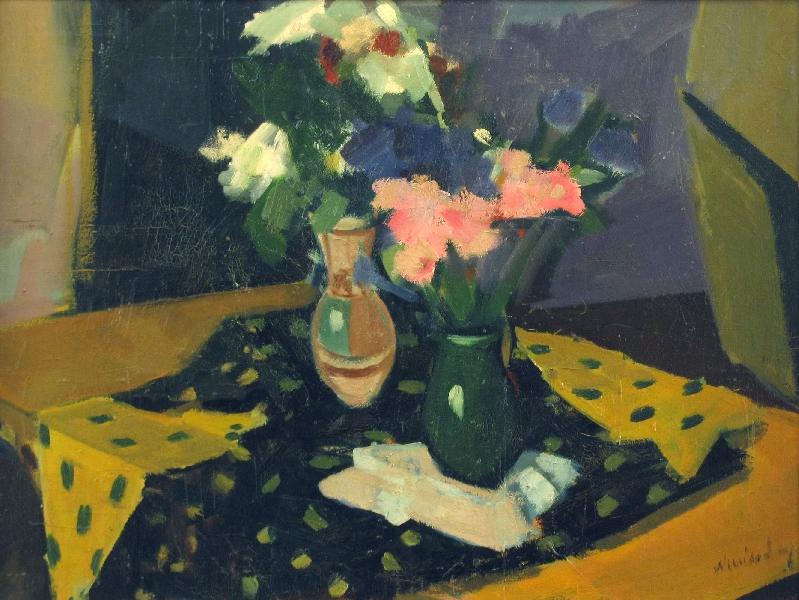
Zoltan Nuridsany (1925-1974)

Zoltan Nuridsany was born on the 22nd of August, 1925, in Romania.His father was Armenian and a mother was a Hungarian.During his secondary school years in Budapest he became a pillar of the Fine Arts Circle under the direction of the graphic artist, Nandor Nagy. In 1944, as a result of his conscious preparations, he gained admission to the College of Fine Arts.

Self-Portrait, 1940s

From 1946 on, he began to exhibit his works in the exhibitions of the so-called European School. His supporters considered him as a member of new generation of the European School and as a college student of an earnest and promissing talent. In 1948 he received a grant of the Human Academy of Rome. The works made there met with success on the Bursars' Exhibition.

Naturmorte

In Oktober of 2000, Nuridsany's works from the European School period, exhibited in Yerevan.


Source
http://www.nuridsany.hu/

Monday, April 16, 2012

Minas ( 17th century )

Arakel of  Tabriz expresses his admiration for painter Minas, who trained in Aleppo under European Masters.In the 17th-18th centuries Aleppo was a great trade centre and numerous European painters enriched its artistic tradition.As Arakel of Tabriz mentions, returning to Persia, Minas painted in oil, watercolours, coal.Apart from that, he was distinguished for his good portraits when portrait painting was not much developed in the East. 


He was appereciated by Shah Safi, Who had seen his paintings at the residences of notable Armenians.The paintings of the houses of Khodja Safraz and Petros Velijanian, part of the frescos in the palace of Shah Abbas and Shah Safi , as well as several paintings in Amenaprkich monastery are ascribed to Minas.His paintings reveal his particular style, that was based on a combination of Armenian, Persian and European Art.


Sources
Les Arméniens Dans Le Commerce Asiatique Au Début de L'ère Moderne
 By Sushil Chaudhury, Gegham Gewonean, Kéram Kévonian

The Fire, the Star And the Cross: Minority Religions in Medieval And Early Modern Iran
 By Aptin Khanbaghi